Study in Germany
Tuition, visas, work rights, and settlement options explained.
Book free consultationWhy You Should Study In Germany
Germany is the only major study destination where you can access world-class universities at little to no tuition cost. Most German public universities charge only a semester contribution of around €200 to €400. That figure is not missing a zero.
What catches students off guard is not the tuition. It is the blocked account requirement. Before you can receive a German student visa, you must deposit €11,904 into a government-recognised restricted bank account. This money is yours and you withdraw it at €992 per month once you arrive, but it must exist and be available before your visa is approved. For many students, this is the main financial hurdle to plan for.
Once that is understood and accounted for, Germany makes strong sense for students pursuing technical subjects, research, or engineering who want international credibility without the debt that comes from studying in the UK, Australia, or North America.
This page helps you decide:
- How the blocked account works and whether you can realistically meet the requirement
- Which German city fits your budget and career goals
- Whether you need German language skills and how much that affects daily life and employment
- What the post-graduation job seeker visa offers
- Whether Germany's level of structure and planning expectation suits you
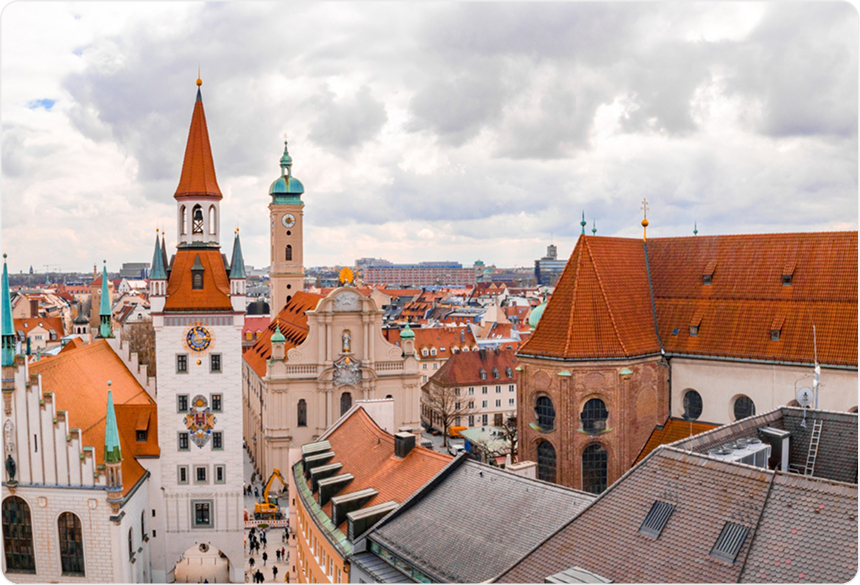
Who Germany is best for

Tech students
Students pursuing engineering, computer science, mathematics, physics, or research-heavy programmes who want access to some of the world's best technical universities at minimal tuition cost

Budget planners
Budget planners who can meet the blocked account requirement and then benefit from the lower ongoing cost of living compared to the UK, Australia, or North America

Students who like structure
Organised students who prepare carefully, because Germany's immigration and university systems reward preparation and penalise last-minute decisions

Long-term settlement seekers
People considering long-term European settlement who want to build from a stable, structured foundation
What it actually costs
Tuition range
Most public universities charge only semester contributions of €200 to €400 every six months. Private institutions charge full tuition. Confirm before applying.
Blocked account
Blocked account: €11,904 must be deposited into a government-recognised blocked account (Sperrkonto) before applying for the visa. On arrival, you access €992 per month. This is your own money returned to you, but it must be available before the visa is issued.
Visa processing times
Processing times vary depending on your country and local German embassy. Apply well in advance of your intended start date.
Living cost estimate
€900 to €1,600 per month. Munich is Germany's most expensive student city. Berlin, Leipzig, and Dresden are significantly more affordable.
Note: We'll confirm your exact budget based on your city, school, and family size during your consultation.
Key things to note
- The blocked account is mandatory for non-EU students. It must be opened with a recognised provider such as Fintiba or Expatrio before your visa appointment.
- Winter intake is Germany's primary intake. Most programmes begin in October or November. Some offer summer intake in April. Your timeline must align with your chosen intake.
- Language: many master's programmes are available in English, particularly in STEM. However, daily life, part-time work, and long-term employability all improve significantly with German. Students planning to stay and work in Germany after graduation are strongly advised to start learning early.
- Post-study: Germany offers an 18-month Job Seeker Visa after graduation, during which you can remain in Germany to look for work without needing a specific job offer beforehand. This is one of the most generous post-study windows in Europe.
Schools / regions
We'll help you decide the best university that fits your budget
Bavaria
Munich is the top-ranked student city in Germany globally, home to the Technical University of Munich and Ludwig Maximilian University, both in the world's top 30. It is the strongest German city for engineering, technology, and business, with BMW, Siemens, Allianz, Microsoft, and Google all based here. The highest monthly costs in Germany, but the employer density and career access make it the top choice for technical and business students.
Berlin
Germany's capital is its most culturally dynamic city and most affordable major student hub. Over 30 universities and a large international population make it the widest-ranging option academically. Strong for creative industries, technology, startups, and humanities.
Baden-Württemberg (Stuttgart and Heidelberg)
Stuttgart is Germany's automotive capital, with Mercedes-Benz and Porsche headquartered here. Heidelberg attracts students in medicine, natural sciences, and humanities. This region suits students seeking rigorous academic environments with direct industry connections.
The North (Hamburg)
Hamburg is Germany's second-largest city and its main trade and logistics hub, with strong maritime, aerospace, and media sectors. Suits students in business, logistics, international trade, and media who want a major city without Munich's price tag.

How Shuri supports you end-to-end
Timeline:
Profile review (budget, background, dependants, timelines)
Country and school pathway planning
Document and application support
Visa readiness and submission guidance
Pre-departure planning (housing, guidance and initial plan)
Profile review (budget, background, dependants, timelines)
Country and school pathway planning
Document and application support
Visa readiness and submission guidance
Pre-departure planning (housing, guidance and initial plan)
Are you ready to plan this properly?
We help you choose the right country, school and pathway based on your real situation.
Book a Free Consultation