Study in Malta
Tuition, visas, work rights, and settlement options explained.
Book free consultationWhy You Should Study In Malta
Malta is the only EU member state where English is an official language, and for Nigerian students evaluating European destinations, that distinction carries real weight. At the University of Malta, the country's sole public university, international students study in English across a broad range of programmes without the language adjustment that studying in Germany, France, or the Netherlands invariably involves.
The cost of living is meaningfully lower than Western or Northern Europe, and as a full EU member, Malta opens the same long-term residency frameworks that larger European destinations offer. The planning question that shapes every Malta decision, though, is not whether you can get in or afford to be there: it is what you plan to do after you graduate, because the local job market is small and the students who get the most from a Maltese education come in with a clear picture of where they are heading next.
This page helps you decide:
- Whether your programme is available in English at the University of Malta and how competitive entry is for international applicants
- What the real monthly costs look like in Valletta, Sliema, and Msida against your actual budget
- What post-study work and EU residence options exist, and what they require from you
- Whether Malta's small labour market is a dealbreaker or a manageable constraint given your longer plan
- What the student permit process looks like for Nigerian applicants and what financial evidence you will need
Who Malta is best for

The EU-path planner
You want a European degree in an English-speaking country without UK or Irish price tags. Malta delivers that combination and, with EU membership, gives your qualification genuine standing when you move on.

The cost-conscious postgraduate
Your priority is minimising debt while gaining a credible international qualification. Malta's fees and living costs are among the lowest in the EU, and the English-language environment removes the adjustment cost of studying in a second language.

Career-switcher
You see Malta as step one of a longer European trajectory. You understand that completing a degree in an EU member state builds legitimate standing for skilled worker applications in Germany, the Netherlands, or elsewhere, and you are planning accordingly.
What it actually costs
Tuition
The University of Malta charges non-EU international students approximately €4,000 to €6,800 per year at undergraduate level, and €5,500 to €12,000 per year for postgraduate taught programmes, with health-related programmes at the higher end. EU and EEA students pay no tuition under Malta's stipend scheme, but this does not apply to Nigerian students (subject to change, verify with the University of Malta admissions office).
Proof of funds
Maltese immigration authorities require approximately €8,400 per year (around €700 per month) in accessible savings or guaranteed income. This is assessed as part of the residence permit application (subject to change, verify with Identità, Malta's immigration authority, before applying).
Visa or student permit fee
The long-stay visa (Type D) fee is approximately €100. The residence permit card fee in Malta is approximately €27.50, with processing fees applied separately (subject to change, verify with the Maltese embassy responsible for your region).
Monthly living costs
Valletta and Sliema: €900 to €1,300 per month. Accommodation typically runs €500 to €750 for a shared room or studio. Msida and Gzira (closest to campus): €750 to €1,050 per month. Most University of Malta students live here and costs are noticeably lower than the tourist-heavy areas. Gozo: €600 to €850 per month. Affordable, but the ferry commute to the main campus makes this impractical for most full-time students.
Note: We'll confirm your exact budget based on your city, school, and family size during your consultation.
Key things to note
- The local job market is small, and this is not a minor caveat. Malta has a population of around 500,000. Graduate employment is concentrated in financial services, iGaming, tourism, and a growing tech sector.
- There is no dedicated graduate job-seeker permit. After completing your studies, staying in Malta to work requires a job offer and an employer-initiated Single Permit application. Students who want time after graduation to search for roles will find Malta's system less flexible than the Netherlands' Orientation Year or the UK Graduate Route.
- Schengen membership applies in full. With a valid Maltese student residence permit, you can travel freely across 26 Schengen member states for short stays.
Schools / regions
This page helps you decide the best region for you:
Msida and the University Campus
Msida is where the University of Malta's main campus sits, and for most international students it is the practical centre of student life. The area is dense and busy, with a good mix of affordable restaurants, shared housing, and reliable bus connections to the rest of the island. Rents here are lower than in Sliema and St. Julian's, making it the sensible first choice for budget-conscious students who want to minimise commute time. The waterfront at Msida is pleasant and the area has a genuine student-community feel that the more tourist-heavy parts of the island lack.
Valletta and the Three Cities
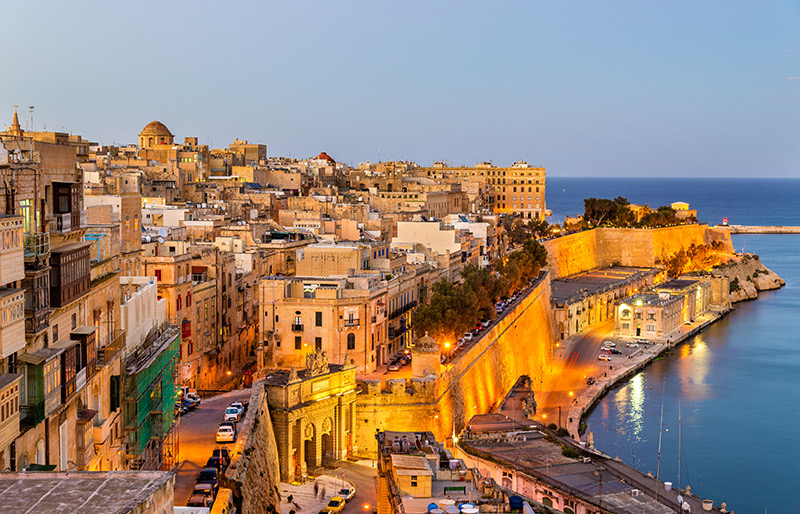
Valletta is Malta's capital, a UNESCO World Heritage city, and one of the smallest capital cities in the EU by area. It is culturally and historically significant, and a meaningful number of students choose to live here for the atmosphere and for proximity to government institutions, financial services firms, and arts organisations. Costs here are on the higher end of the Maltese scale, and the housing stock is older and sometimes less well-maintained than newer apartment developments elsewhere. Students in policy, law, cultural management, or heritage-related programmes often find Valletta the most professionally connected place to be.
Sliema and St. Julian's
These are Malta's most cosmopolitan areas: higher density, more international, more expensive, and more socially active than the rest of the island. Sliema and St. Julian's are where the iGaming and tech sectors are heavily concentrated, and students with ambitions in those industries often position themselves here for networking. Budget around €200 to €300 more per month compared to Msida. The areas are well-connected but can feel transient, particularly in summer when the population swells with tourists and seasonal workers.
Gozo
Gozo is Malta's quieter sister island, connected to the main island by a short ferry crossing. It is occasionally considered by students enrolled in distance or blended programmes, or those whose personal circumstances make a slower pace of life more appropriate. Costs are the lowest on the archipelago, and the environment is significantly less urban than anything on the main island. For the vast majority of University of Malta students, Gozo is not a practical primary base: the ferry crossing adds meaningful time to daily commutes, and most academic and social activity is anchored on Malta itself. That said, for students who have flexibility in their schedule and are working partly remotely, Gozo represents genuine value.

How Shuri supports you end-to-end
Timeline:
Profile review (budget, background, dependants, timelines)
Country and school pathway planning
Document and application support
Visa readiness and submission guidance
Pre-departure planning (housing, guidance and initial plan)
Profile review (budget, background, dependants, timelines)
Country and school pathway planning
Document and application support
Visa readiness and submission guidance
Pre-departure planning (housing, guidance and initial plan)
Are you ready to plan this properly?
We help you choose the right country, school and pathway based on your real situation.
Book a Free Consultation